After a decade of what I can only describe as an extremely productive dissolution and reconfiguration, this spring I am opening True Names Workshop. I will offer tarot readings, astrological chart work, archetypal story, and secular ceremony design for people at transition points in their lives. The archetypal story work draws on mythology and literature alongside comics, games, anime, fantasy, science fiction, anywhere we find meaningful stories. Stories were the companions of a relatively isolated childhood that I took with considerably more seriousness than anyone around me thought was strictly necessary, and which have turned out to be professionally relevant.
The name comes from Ursula K. Le Guin’s Wizard of Earthsea, who understood that to know the true name of something is to see it clearly, and it is a workshop because I am working with specialized tools I have developed expertise with, to perform essential maintenance work. This essay is an attempt to do that for the work itself, and for the person doing it. Both are works in progress. Please consider this essay my announcement and reintroduction.
This Is What I Do Now: Finding a Vocation at the Threshold
I have never entirely lived inside consensus reality. This isn’t a complaint anymore, though at many points it has been. Now it’s more a fact about the terrain. You know that moment at a party where you look around the room and genuinely cannot locate where you belong in the social geometry currently in progress? For most people that’s a familiar but temporary disorientation. For me it has always been my default position. Over the course of my life I’ve gotten quite good at working from there. It turns out to be surprisingly useful real estate.
Gym class was for me a years-long exercise in the specific variety of dread that I imagine most people reserve for situations of genuine mortal peril. My body in space, relative to other bodies in space, moving at speed, toward or away from objects also moving at speed, governed by complex structural guidelines, the whole enterprise felt like being asked to simultaneously solve a differential equation and perform a violin concerto, in public, while people threw things. I am relieved to have that chapter behind me. I am less relieved that I still occasionally find myself at picnics face to face with someone who is warmly, enthusiastically, unshakeably certain that I would love to play a game of badminton if I just gave it another try.
I would not love to play badminton. I have made my peace with this.
The sensory experiences that have accompanied me since childhood, chronic dizziness, a poor sense of where my body existed in space, tediously frequent vomiting, the overall impression that my body was conducting its own separate and not entirely friendly agenda, were labeled dramatic or psychosomatic when a direct physical cause wasn’t immediately apparent. It took years of science, and the illuminating stress to the body that comes with pregnancy, for the medical framework to catch up with my experience.
The lesson I absorbed in the meantime, with the particular thoroughness of a child who takes things very literally, was that my interior signals were not to be trusted. That my body was an unreliable narrator. This turned out to be exactly the wrong lesson, and unlearning it has been one of the longer projects of my adulthood.
I was also, from very early on, frequently and genuinely delighted by certain territories that most people find uncomfortable or strange or not particularly worth lingering in. The existential questions that make some children anxious felt to me like a cozy retreat. The great stories, the ones with hefty mythic weight, the ones that were about something fantastic but inherently true, were a parallel country I inhabited with complete seriousness and considerable joy.
The stories were more comprehensible than most social situations. I took them with the complete devotion they deserved, and that most of the humans around me found faintly alarming, and they have been my primary symbolic language ever since. Ursula Le Guin wisely observed “I believe that maturity is not an outgrowing, but a growing up: that an adult is not a dead child, but a child who survived.” I am proud to be the child within me, and of how she and her wisdom have survived.
And then there was the woods.
I grew up deep inside transitional Vermont forest; logging land only a few decades reclaimed, wide-spaced softwood evergreens, ostrich ferns that reached over my head for most of childhood. Remnants of stone walls abandoned mid-clearing, half-swallowed by moss. Thin flexible birch and quaking aspen coming up between them, pioneer species, the first trees back after the old order has been cleared, neither what the land was nor what it was becoming. I didn’t know the word liminal yet, though I was living inside it.
Forests have always known something about transformation that human beings have been trying to articulate for as long as we’ve been telling stories. Every folklore tradition that sends its heroes into the dark wood understands instinctively what the forest actually is; not simply a place of danger or enchantment, but a place where both things are happening simultaneously. Life and decay occupying the same space, the fallen tree becoming food and residence, the path forward running directly through the place where something else is ending.
Hansel and Gretel, Little Red Riding Hood, Wart before he was Arthur, every hero who enters the dark wood and emerges changed; the forest is the underworld made walkable. The place you go when the ordinary world has run out of answers and something more fundamental needs to happen.
I would go alone. I would find a spot that had a particular quality; some combination of light and silence and the specific arrangement of things that made it feel charged with something I couldn’t name, and I would sit in it. I was having genuinely numinous
Numinous: From the Latin numen, meaning divine will or presence. It describes the quality of an experience that feels charged with something beyond the ordinary, without requiring any specific claim about what that something is. I am very glad the word exists.
experiences on a fairly regular basis. I was also, simultaneously, waiting for them to produce a more dramatic confirmation. A talking fox or fisher cat, ideally. Some concrete manifestation of the something-more I could already almost touch.
The forest declined to provide the fox. The numinous moments remained stubbornly themselves; real, full, complete, and insufficient. I kept wandering out to those spots anyway. This was, it turns out, the correct response, and also probably the beginning of everything that followed.
The overcast skies of depression that arrived in my teen years reappeared on a rotating schedule, like a comet, or the emergence of cicadas. Weeks spent wandering a landscape of bland and squishy ground, sky a blinding dirty white, the sun refusing to warm or color. I’ve climbed back out of that place enough times to know the route fairly well. My questionable executive functioning and working memory, unaided in any useful way for most of my life, built in me a specific and thorough shame about the gap between my capacity and my output that took years to accurately diagnose as a structural and chemical problem rather than a personal failing.
The last ten years have been recovery from a burnout so complete it required stopping almost everything, the goo in a chrysalis phase that for so many of us is to be found in early motherhood, and marching dutifully forward through a succession of depressive episodes that each demanded their own specific reckoning.
My excavation and reassembly required tools, and I found them in tarot and astrology; not as belief systems but as extraordinarily precise symbolic languages for the kind of interior cartography that recovery demands. I have spent five years studying them seriously, using them on myself first, then moving to offering them to close friends and family (and the occasional Halloween party), the way you would want any craftsperson to have done before they offered the work to anyone else. What I learned in that process is now my practice.
(I want to be clear about something that tends to get lost in the way I write: this work is genuinely, straightforwardly fun. The perpetual study, pulling a card and knowing it well enough to immediately see that here it speaks the truth bluntly, the moment when the right archetypal character clicks into place for someone’s chart and you can feel the recognition land; this is what a good time looks like for me. It looks a lot like the other things that have always been what a good time looks like for me. Many of you will recognize this somewhere in your own lives: the interest that everyone around you treats as either impressive or slightly alarming, that you would do anyway, for free, forever, because it is simply what enjoyment is. The fact that it has turned out to be useful to other people is, honestly, a delightful bonus.)
What can read to others as thinking I have it figured out, is almost exclusively scaffolding. The constant study, the system building, the matter of fact manner, the overexplaining, these are the coping structures of someone who had to build their own framework for existing because the available ones didn’t welcome or make room for them. I’m telling you this because it’s directly relevant to what comes next.
Across cultures and throughout recorded history, the person who occupies the liminal role in a community, the one who helps others navigate thresholds, who perceives pattern in what others experience as chaos, who holds the symbolic frameworks that make transition legible, is frequently, with striking consistency, the one who already lives there. Not by choice, exactly. By the particular shape of their neurology, their suffering, their structural exclusion from ordinary social participation.
The shaman whose initiatory illness strips away the ordinary self before the larger role becomes possible. The oracle whose difference marks them as set apart from the normal flow of communal life. The fool whose perceived otherness grants them the freedom to say what everyone else is carefully not saying. The gnarled wise woman whose knowledge of the hidden workings of things developed precisely because her relationship to the community was never entirely standard. These figures appear across wildly different cultural contexts because they describe something structurally true; that the person who lives at the threshold is the one most equipped to help others cross it.
And then there are the figures who don’t just inhabit the threshold but are defined by it. Hecate at the three-way crossing, Hermes moving between the living and the dead, Charon at the river that separates one world from the next, Eshu at the crossroads in the Yoruba tradition, Papa Legba arbiter of human-divine communication of the West African Vurdun (and all its diaspora,) without whose presence no communication between realms is possible. These are not wisdom figures in the elevated sense. They are threshold functionaries. They don’t live in a palace, they live at the crossing. That is the job, and it is a job like any other; specific, skilled, necessary, and without hierarchy over the people whose crossings they facilitate, except in their discretion of whether to offer that particular function to those seeking passage.
These figures appear across different cultural contexts because they describe something integral about how human communities have always worked. David Graeber and David Wengrow, anthropologist and archaeologist respectively, argue in The Dawn of Everything that these roles we tend to think of as marginal have historically been anything but. The wisdom conduit, the keeper of symbolic frameworks, the one who knows the territory of dissolution and return, these are critical, functional figures. We find the framework, again, struggling to keep up with the actual human beings operating inside it.
The way I have always perceived the world, at a slight angle to most people’s default settings, noticing what others don’t and missing what others find obvious, building elaborate internal frameworks to navigate social geometries that others seem to inhabit intuitively, is not a liability for this kind of work. It is useful, maybe even necessary. The years I spent not understanding why the gap between what I was capable of and what I could produce felt so insurmountable, accumulating a thorough and specific shame before I had any true structural explanation for the gap, gave me an intimate understanding of what it costs to be misread by the frameworks available to you. Which turns out, is directly relevant to work that is largely about finding better ones.
Like famous migraine sufferers Hildegard of Bingen, Lewis Carroll, and Joan Didion, the chronic pain that makes regular withdrawal from ordinary productive life not a choice but a recurring fact gives me an involuntary and on-going residency in the liminal that no amount of forest-sitting could have produced on its own. The depression that returns and requires the same difficult climbing back out each time has given me, among other things, a reliable knowledge of where the handholds are.
And the forest and the stories gave me the delight. The early understanding that the threshold is not only a place of difficulty but a place of genuine wonder, that the numinous is real even when it declines to provide the fox, that sitting in an illuminated spot in the woods waiting for something that doesn’t quite arrive is not a waste of time, but a practice.
I am not making a romantic argument about suffering. The romantic argument is both false and annoying and I have no interest in making it. What I am saying is that the particular combination of experiences that have marked me as me are directly generative of my suitability to do this work, and structurally critical to it.
I am in the middle of the transition into this role, not on the other side of it. My work within True Names Workshop is not the view from the summit. It is something being built during the journey, by someone who has learned enough about the terrain to be useful to others navigating it, and who is still very much navigating it herself. This essay is not a retrospective. It is a threshold document, written from inside the crossing. I mention it because the people most likely to need what my practice will offer are probably also in the middle of something, and I would rather they find a fellow traveler than a pretender to authority who has forgotten what the middle feels like.
The framework, you might say, has finally caught up with the actual human being. Mostly. We’re working on it.
Humans leave walls in places and then leave. The forest doesn’t hold this against them.
Those stone walls half-swallowed by moss in my childhood forest weren’t failures or abandonments. They were an earlier layer of a place that had always been in conversation with the people passing through it. Human presence moves through landscapes the way it moves through everything; leaving marks, retreating, leaving different marks. The walls became part of the ecosystem rather than its organizer. The ferns grew up around them. The pioneer birch found purchase in their gaps. The conversation continued in a different tone.
This is true of the internal landscape too. The half-cleared places, the projects abandoned mid-threshold, the boundaries that got swallowed by whatever grew back; these are part of the same continuous conversation between human presence and the terrain that holds it. Despite what tiktoks about the divine feminine or lost Indigenous wisdom might tell you, the liminal wisdom role isn’t something humans invented and then lost and now need to recover. It’s something that has always been present in human communities in different forms, ebbing and flowing, leaving different traces in different eras, but never truly absent.
The Atheopagan understanding of ritual and ceremony makes the anthropological claim plainly: humans need these experiences. Not some humans, not spiritually inclined humans, not humans who haven’t yet discovered rational thinking; humans, as a category, require shared ritual and ceremony to be fully themselves. This is not a mystical position. It is an observation about how human communities have always actually worked, in every culture, in every era, without exception. The forms change but the function doesn’t.
What I have found, as I have crawled out of my metamorphic goo state, is that I am someone who does that work. Built by a particular combination of neurology, illness, forest, story, and stubborn attention into someone with genuine access to the territory that work requires. This is a job. It requires specific skills that are learned and developed over time. It requires a particular kind of attention that is partly innate and partly built through experience. It can be done well or badly. It can be compensated fairly or exploited. It fits inside a community the way any other necessary skill fits, woven into it, load-bearing in ways that only become visible when it’s absent.
Before this wraps up, I need to say something carefully about the communities I belong to; the neurodivergent community, the chronic illness community, the Atheopagan community, because there is a temptation in all of them, understandable and human and worth resisting, toward a kind of categorical pride that tips into its own hierarchy.
The idea that autistic people have a purer sense of justice, or that those who have suffered have earned a moral authority others lack, or that the highly rational and spiritually practiced occupy a different plane of understanding; these are the same categorical error in different clothes. They replace one hierarchy with another and call it liberation. What I have is a specific nervous system, with specific capacities and specific limitations, that has been shaped by specific experiences into something useful for specific work. That’s all, and that’s enough.
The forest doesn’t have a hierarchy. It has an ecosystem. The ostrich ferns aren’t humbler than the evergreens. The pioneer birch isn’t more enlightened than the stone wall it’s slowly reclaiming. They’re all just doing what they’re built to do, in the place they actually inhabit, in the service of something larger than any of them individually.
The numinous moments in the forest were real. The talking fox never came. I kept showing up anyway, and eventually built something out of the waiting. Which brings me to the threshold I am currently standing in. Not the forest threshold, not the archetypal one, but this specific and slightly terrifying one: the moment of picking up tools you have spent years developing in private and offering them to other people. Of saying, plainly and without excessive qualification (she says nearing word 3,000 of this essay), that this is work I am genuinely equipped to do. That my one step forward three steps back life built something real. That the vocation, however long it took to find and however much it cost to become possible, is actual and present and mine.
True Names Workshop is that claiming. This essay is part of it. Both are, as noted, works in progress, but they are works in progress that are actively in progress, which is different from what came before.
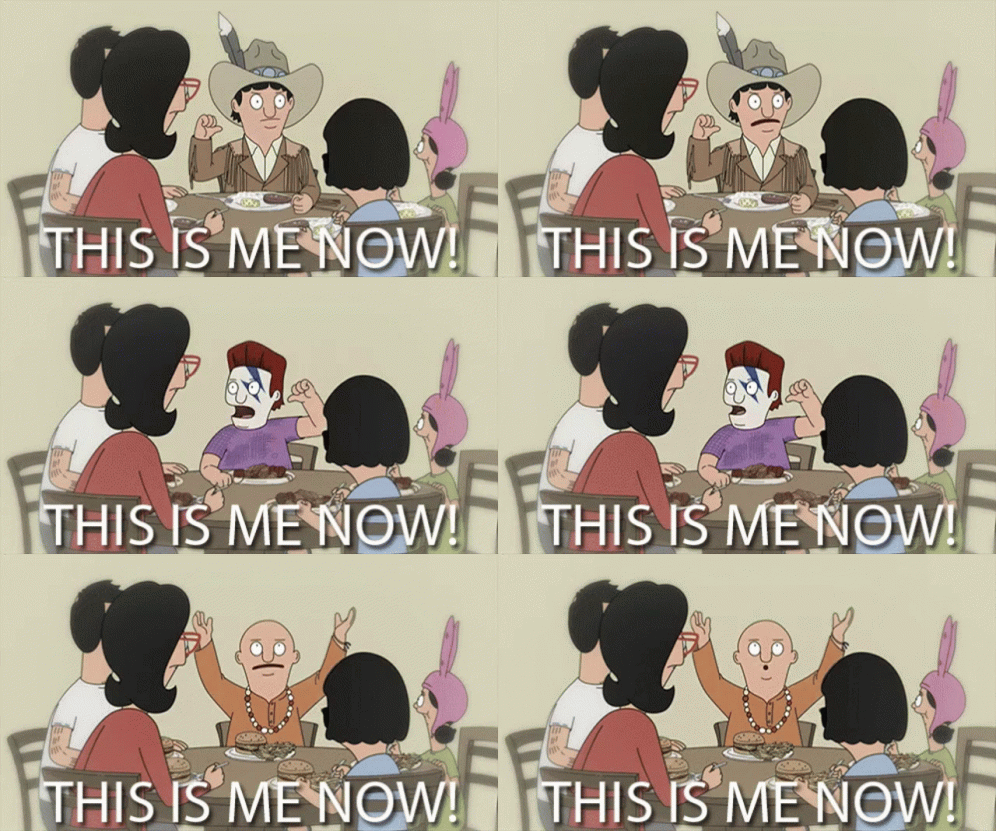
This is what I do now. And because of my specific brain, all I can think of is Gene Belcher, declaring “THIS IS ME NOW!” There will be other mes in the future, but this one has just emerged, and I’m happy to be her.