In February, our house sometimes swells with extra children during school break. Parents need to work; the snow is deep; the days are short. When I have the chance, I send a kid or two, those who want to play outside anyway, into the snow with poppy and hollyhock seeds to scatter across the frozen Vermont ground. Clumsy, mittened fingers grasp the packets, and seeds skitter across the icy surface. Looking out the window, I cringe, thinking I may not want a tower of six-foot flower spikes just there, but that’s part of the bargain.
They don’t bury them. We don’t say anything special. The seeds sit there through the rest of winter, cold-stratifying in place, and in the spring they get to decide when to come up. More often than not, they become taller, sturdier plants than the ones I carefully transplant from seed cells. When no extra children are around, my own child and I bundle up together, scattering seeds as quietly as prayers. The hush of the snow-covered landscape, in the absence of all the direction I am resisting giving him, is almost deafening. My struggle in both situations points to one of the day’s lessons: how letting go sometimes yields more than careful tending. Research on embodied cognition and intrinsic motivation suggests that people, children especially, learn most deeply when autonomy is treated not as a reward, but as a condition of growth. The seeds that thrive without supervision feel like a botanical argument for that science.
I don’t believe in gods, spirits, or unseen forces arranging meaning on my behalf. And yet, having children scatter seeds each February is part of my religious practice.
The tradition I eventually found a name for, Atheopaganism, is a non-theistic practice centered on seasonal change, community care, and deliberate meaning-making. What matters more than the definition is that the practice gives me an imperative to remind February children that an action they take right now can create the tallest flowers of summer months later, and to let that truth land in my own body as well.
Anthropologists have long argued that religion is less about what people believe than what they do together. Ritual, stripped of supernatural claims, emerges as one of humanity’s oldest and most reliable technologies for turning attention into care, and care into continuity. Practice often comes first; belief, if it comes at all, follows later. Science seems to point to practice as the critical component. At a moment when religious affiliation is declining but loneliness and meaning-hunger are rising, I argue that the loss we’re feeling isn’t faith in a higher power, it’s the disappearance of shared practices that help people locate themselves in time, place, and community.
There’s a shelf above our stove where I keep a few small objects that belonged to recently deceased family members. It isn’t elaborate. A chess knight that belonged to my father-in-law, who was above all unconventional and calculating. A rosy-cheeked nesting doll from my grandmother, who loved adorable things and lined the shelves of her remote log cabin with them. A single Wedgewood soup plate from my great-grandmother, who served us strawberry Jell-O and Cool Whip in her good dishes nearly every time we visited.
The chess piece was the first. After my father-in-law’s death, we found this lone knight saved while the rest of the set had disappeared in one of his many chaotic moves. It was so perfectly emblematic of him that I felt it needed a place where it could metaphorically watch over us. Now it helps me conjure his oft repeated, emphatic words of praise, “y’all are so shrewd!” delivered in a heavy North Carolina drawl, knowing he would approve of what our little family is up to.
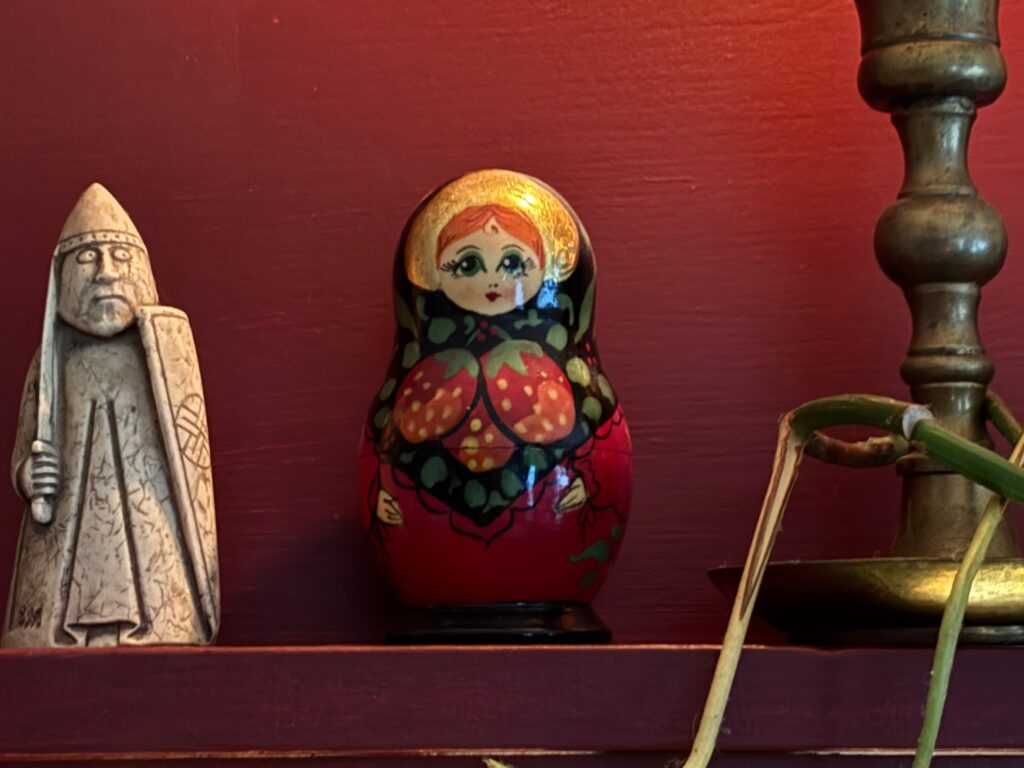
Having these objects in my regular line of sight reminds me that my life is part of a longer story, that I’m carrying plotlines I didn’t originate, and that I’ll pass some version of them on. Cognitive scientists describe this as the “extended mind”: the idea that human thinking doesn’t stop at the skull, but relies on objects and environments to scaffold memory, identity, and moral orientation. Across cultures, ancestor practices often work less as expressions of literal belief than as ethical anchors, keeping the living oriented toward continuity and responsibility.
Outside, in the dark, my husband is jumping our new-ish neighbor’s car. It’s thirteen degrees, and the cold has drained the battery. I’m glad that by the time it’s done, they’ll know each other a little better, and that our neighbor will know, more deeply than before, that we’re here for her in times of need. My husband will ask for her help with greater ease when the moment comes that he needs it.
Because I’m a homemaker, lifelong self-directed student, and homeschool facilitator for my son, my schedule allows me to offer childcare to friends who need it. I’ve learned to be clear on exactly how much I can handle: two extra children comfortably, three if they play well together, and never for more than a few days at a stretch. On mornings when extra young friends will be joining us, I briefly mourn the quiet day that could have been before consciously reaffirming that I am still glad we opened our home. I can’t help everyone all the time, but I can help some, some of the time. To me, these acts of community care are demanded by my system of belief, as much as any Christian feels the responsibility to contribute when the offering plate is passed, though not out of not out of obligation, but because our lives are richer when our roots are thick and nearby. I did not arrive at this logic through belief; I arrived at it through practice.
We homeschool my son following the principles of self-directed education, and for me it grows out of the same instinct as scattering seeds into winter snow. Research on intrinsic motivation and learning, particularly decades of work in developmental psychology, suggests that curiosity thrives when autonomy is protected rather than managed. In our family, curiosity and inquiry are held as sacred values: not in the sense of being beyond question, but in the sense of being worthy of care. In a way, by my own logic you could say we homeschool for religious reasons. This also means in addition to self-directed education at home, our family actively advocates for and supports actions that improve the state of children’s rights and developmentally appropriate expectations of all kids, at home and at school.
Much of my participation in my son’s education happens not through instruction, but through modeling. I am a lifelong, self-directed student, and my ongoing studies, reading, researching, taking classes, creating and appreciating art, following questions wherever they lead, are part of the landscape of his childhood. Learning here is not something that happens to children while adults supervise from a distance; it is something we do visibly, imperfectly, and together. If I take the science of learning seriously, then structuring my child’s days around compliance, pacing guides, and external incentives would feel like burying seeds on a schedule and insisting they sprout on command, regardless of how hostile the growing conditions might be.
From the outside, my life often looks religious. I keep an altar. I observe seasonal holidays. I use tarot and astrology. People reasonably assume I believe in something supernatural. I don’t.
I use tarot as a symbolic system, not because I think it’s true, but because I’ve found it useful. In our family, curiosity and inquiry are held as sacred values: not because they offer answers, but because they protect uncertainty long enough for better questions to emerge. I’ve spent years learning the deck, its archetypes, and the narrative arc of the Fool’s Journey. When I do a reading, I treat the cards as a random sampling of familiar symbols that constrain how my mind approaches a situation. They limit the story I tell myself just enough to make it clearer.
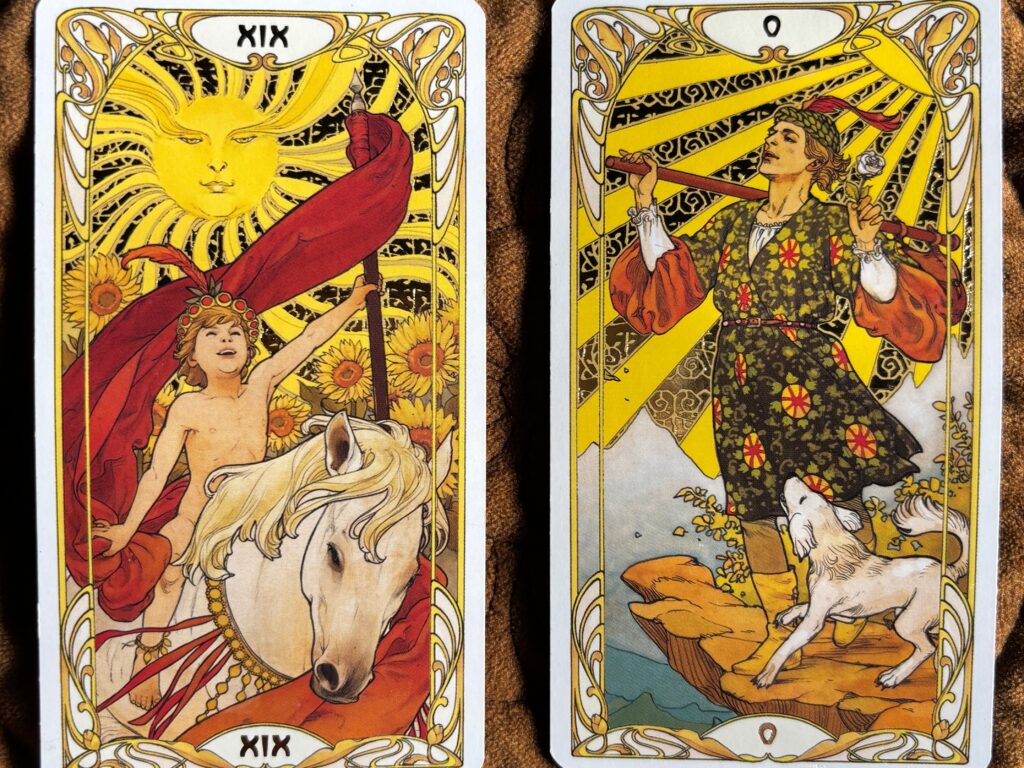
Cognitive scientists studying creativity have found that constraints, especially arbitrary ones, often produce deeper insight than open-ended reflection. Tarot functions, for me, as a projective system: not a window into the future, but a mirror that slows the mind to the pace where meaning can take shape without urgency.
On the morning of my son’s tenth birthday, I sifted through one of my decks looking for its particular depiction of The Sun, which has always reminded me of him: a smiling, curly-haired boy crowned in flowers, proclaiming joy. My Sun. Instead, The Fool caught my eye. At his off-balance but confident step into the unknown, his flashy outfit, his youthful vigor, I was hit with cathartic tears and the realization that my son had entered a new era. Anthropologists call moments like this liminal: the charged space between roles, when meaning is most available to conscious reflection. The cards didn’t tell me anything new. They protected my uncertainty long enough for pride, grief, and awe to take shape into something I could hold.
Astrology offers me a similar structure. I don’t believe in determinism. I believe in lenses. The astrological calendar externalizes time, ensuring that different domains of life, rest, ambition, intimacy, creation each get a season of focus. From a cognitive perspective, it functions like any good planning framework: a way to distribute attention so that no single value monopolizes the year.
I came to this way of practicing slowly. Years ago, after watching Tidying Up with Marie Kondo, I became curious about the rituals accompanying her decluttering practices. I learned that Kondo had trained as a Shinto temple attendant, and that in Shinto, participation often matters more than literal belief. Many people take part without identifying as believers at all.
Soon after, I read about open-label placebos, treatments that still work even when people know they’re placebos, and about the neuroscience explaining why. Expectation, structure, and care, it turns out, are often enough. I moved forward with the understanding that usefulness and truth aren’t always aligned.
Eventually, I found a community of secular people practicing what’s sometimes called Placebo Magick: symbolic rituals used to create psychological shifts, no supernatural forces required. And finally, I found Atheopaganism, which offered me ritual, reverence, and tradition without dogma or cultural appropriation. Each discovery felt like a resonant bell ringing from within, bringing me closer to understanding how people like me make meaning in the world.
Long before I had language for any of this, my staunchly atheist husband and I planned to marry beside Lake Champlain on the winter solstice, in a stone circle overlooking water that flows north to the St. Lawrence River. A once-in-a-decade ice storm forced us indoors, and the ceremony was hastily reassembled at our reception site. Much went wrong. I forgot my bouquet. The music was a cacophony of well-intentioned but overlapping loved ones trying to keep to their performance cues. I cried through our vows so hard we had to pause while my very soon-to-be husband helped me calm myself enough to continue, in unison with him.
The paper we read from together now hangs framed in our bedroom, reminding us of both the promises we made and the moment we made them. In retrospect, the day offered a different kind of meaning than the solemn majesty we’d planned on. Even surrounded by love, things will not go the way you expect, and the laughter and loosening that follow are often more valuable than any perfectly executed plan.
Some people would read this as a supernaturally bestowed lesson. Others would dismiss the need to see meaning in it at all. The middle road, deriving meaning without underlying belief, is, for me, the most compelling. Psychologists who study narrative identity argue that well-being depends less on a flawless life story than on a coherent one. Meaning doesn’t descend. It gradually accumulates.
I’m now an ordained Atheopagan cleric. I haven’t performed formal ceremonies for others yet, but I hope to. I’ve written baby blessings, marked collective birthdays, and hosted solstice gatherings. I value carefully considering what makes a celebration worthy of attention, because I don’t believe meaning appears on its own. We make meaning together, imperfectly, on purpose, like seeds scattered in winter snow, waiting for the sun to find them.
Further reading:
Atheopaganism by Mark Green
Wintering by Katherine May
Suggestible You: The Curious Science of Your Brain’s Ability to Deceive, Transform, and Heal by Erik Vance
Education and the Significance of Life by Jiddu Krishnamurti