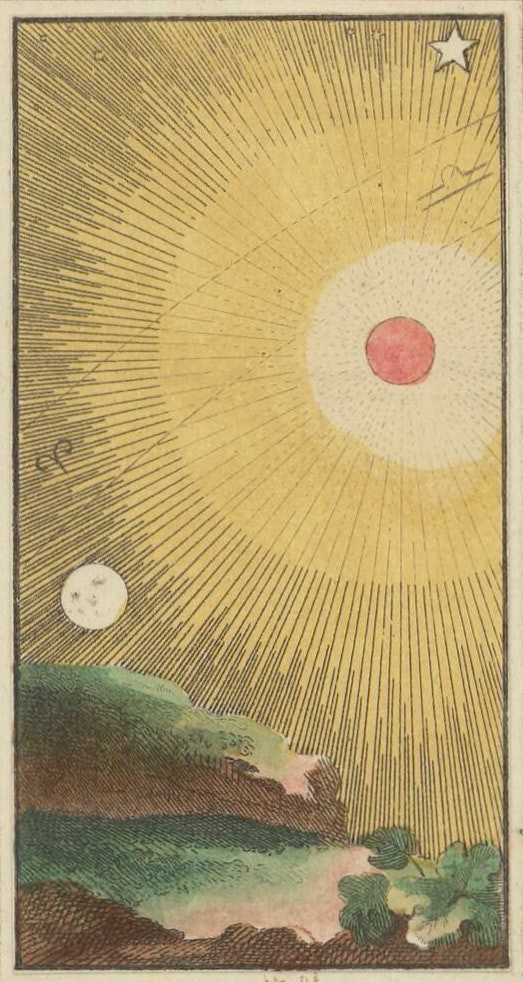
I am, somehow, matter experiencing itself. In a singular pocket of the universe where that occurs in this particular manner; conscious, meaning-hungry, and a blip in the vastness of time. That’s the most miraculous truth I can personally ever think of, and it’s the foundational belief everything I do professionally stands on.
(Image: La Luce, a card from the Etteilla tarot deck designed by Jean-Baptiste Alliette in 1789)
You will see bits from this piece of writing all over this website, because it’s the best job I’ve done so far of describing how and why I work the ways I do, and I see no point finding other, less effective ways of saying them only for the sake of not repeating myself.
I am ordained as an Atheopagan Cleric and often describe myself as an atheist, but I’ve come to think that’s not the most accurate account of how I approach meaning. What I do believe is that anything approaching what humans have conceived of as gods, the divine, or an ultimate force would be entirely beyond our understanding. Pretending to outline the mechanisms of such cosmic intent would be the least honest thing I could do. So I don’t. I only need to know that in my experience, these systems work.
Each time I sit down with them, I recommit to engaging with unwavering honesty, and I refuse to push myself into seeing anything in the cards or stars, or any other symbolic language, that I don’t really see, no matter how useful I think it might be to me or the person I’m reading for. It’s easy to be dishonest or push an agenda in any translation work, and holding myself to a strict and stripped down honesty in regard to what I do and do not read is one of the most critical parts of how I use these practices. What I’m left with is something that likely looks like faith from certain angles, but it’s faith in the meaning-making capacity of the human animal, not in any machinery behind it.
Which brings me to decisions.
Unmade decisions are like deer caught in the headlights of our conscious attention. Startle them with a spreadsheet and they bolt back into the forest of infinite possibilities. Corner them with a legal pad and they run endlessly, growing thin, no breath or strength left in them. But turn your headlights off, quietly build a fire off to the side of the road, sit close beside the warming flames, and begin to tell the decision’s story. They may wander close and settle down. They want to find out what you know about them.
We like to pretend we are jurors in the court of our own skull; labeling exhibits, sharpening arguments, delivering verdicts with procedural dignity. But humans are undeniably creatures of story, and when we approach ourselves as purely rational magistrates we fail to honor that.
It is always going to be more impactful to say “the symbols told me” than to say “I knew.” It’s always easier to credit fate than to trust the quiet authority already living in your body. And so we need to let that authority tell us a story through the cards, the stars, runes, sticks, leaves, whatever symbols we learn to read and write the language of, in order to proclaim our own wisdom.
Stories are a human technology older than our arguments, so ancient it predates the wheel and will probably outlast it. Ursula K. Le Guin, who spent her life demonstrating that story is the primary technology through which humans understand themselves, wrote that we read books to find out who we are, that what other people, real or imaginary, do and think and feel is an essential guide to our understanding of what we ourselves are and may become. The path feels worn because we have walked it before in other guises, watching as others travelled it.
I use the word “Archetypal” a lot. Archetypal is a helpful and specific word for the patterns so old and familiar that humanity keeps accidentally remaking them, all over the world, the way a kid keeps drawing the same sun in the corner of every picture. It’s the original mold for a type of character, story, or idea; the brave hero, the wise old guide, the trickster who causes trouble and then winks about it. When something is archetypal, it feels strangely recognizable even if you’ve never seen it before, because the human race has more or less been passing the blueprint around since the campfire days. Funny species, ours.
I think about various manifestations of archetypal characters the way we represent galaxy spanning political general assemblies in sci-fi. Or detailed character classes in a game. You can clearly identify races by their appearance, their shared cultural traits, their moral valances, their garb, but when you get to know various members of each race as people, they all have vastly different experiences, personalities, faces, and stories. Archetypal characters are the same way.
I have a running document where I keep note of the fictional characters I associate with each of the different major arcana, by way of the shape of the journey they must take, or the way they embody particular principles in their conduct. I note next to each character a few words about why they belong to this archetypal race. Finding the right delegate from these conceptual nations who can act as translator of a card to the person I’m working with in a reading is one of my favorite feelings.
Stories are patient with contradictions. They allow us to be foolish and brave in the same paragraph. Kurt Vonnegut once observed that we are what we pretend to be, so we must be careful about what we pretend to be. A decision told as a story is a rehearsal of becoming. When we narrate our choice, out loud, in ink, in tarot spreads or star charts, we are not escaping responsibility. We are practicing inhabiting the shape of a self who has already chosen.
Our brains, practical and mythic at once, know exactly what to do with a story. They file it in the cabinet marked Meaning. They index it under Survival. A pros-and-cons list may satisfy the inner magistrate, but a story satisfies the non-linear processing systems of the human animal.
So when a decision threatens to bolt, try telling it as a tale. Give it a beginning. Let it want something. Let it fear something. See who you are in its unfolding. You may find that what seemed like superstition is simply trust wearing ceremonial robes. That what the cards said is what you have known all along, waiting for the dignity of narrative to make it speak, and file it under Action Items.
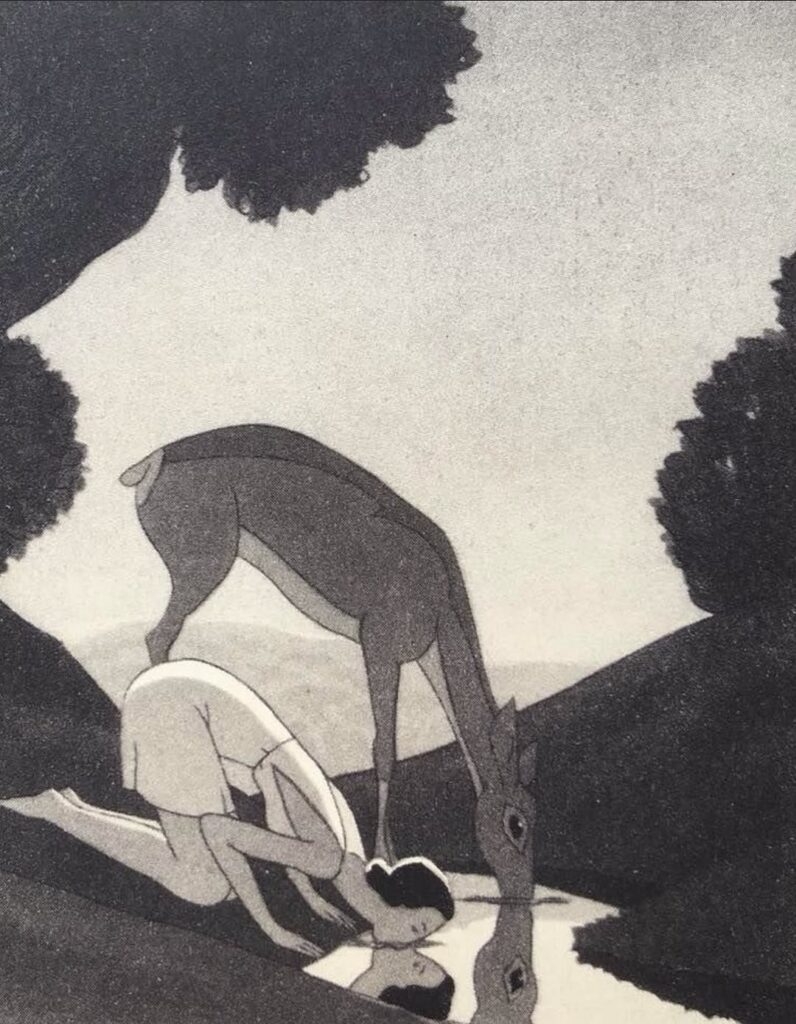
Image: Illustration from the 1937 film Callisto, la petite Nymphe de Diane by André Édouard Marty
And if you’d like, I’d be honored if you’d allow me to be the one to sit beside the fire with you while you learn to tell your decisions their stories.