Or: A little adventure into popular western practices whose histories are much shorter than you’d think, and why being honest when you’ve made things up yourself matters
I’m hoping to make this into my first video essay eventually, but I see no harm in sharing the text version now, and there’s plenty of references and further reading at the bottom for your perusing pleasure. I look forward to working on recording the voice over and finding the right visuals to bring it to life for those who don’t prefer to recreationally read random ladies’ essays online, whom I hold nothing against.
“So how are you celebrating (insert Neo-Pagan holiday name here)?” It absolutely makes sense to me why they ask. I am a person who obviously belongs to the general category of “not part of an explicit religion but seems progressive and does celebrate non-government holidays” that so many gen x and millennials find ourselves in.
And the truth is that I mostly am not, (depending on the holiday, but at very least not by those names), celebrating the aforementioned holidays. I don’t have anything against the people asking, or against anyone who does celebrate them. The reason I don’t celebrate them requires me to explain things that I care about a lot, and I have a general tendency to launch into more explanation than people are ready for in casual conversation, and I’m honestly working really hard on moderating that. Now that I think about it, this is probably a big part of why I started writing essays again; it all needs somewhere to go, somewhere with consenting recipients.
The special interest of mine this one touches on is the value of fiction, and here specifically, the difference between a useful, enriching, honest fiction, and a fiction that has put on a costume of faux-historical fact.
I think I could be easily misapprehended as someone who demands that everything in my practice pass a narrow empirical fact-check. I went through that phase, in my early twenties. I voted for Ron Paul and loved The Fountainhead, I won a scholarship to a raw food only culinary school; this is to say I know from experience that trying to be individually rational about every determination you make in life is not a form of maturity or wisdom.
Fictions are absolutely worthy of reverence. Most of the most clarifying, orienting, genuinely useful material I interact with is fiction; stories, archetypes, invented frameworks that move my mind through territory that helps me understand myself and the world better. The lessons available in a well-crafted fiction make up the greater part of the foundations of all that I’m interested in.
The latter one is the concerning fiction; the one that is granted its authority from a claim to antiquity that simply doesn’t exist, no matter how hard we look. A modern practice that needs to insist that it’s ancient in order to justify itself reveals an underlying doubt about its own foundations. This is in many ways the opposite side of the same coin as the impulse to pretend everything old, culturally wise, and not european is actually new, for sale, and that a modern western person thought of it.
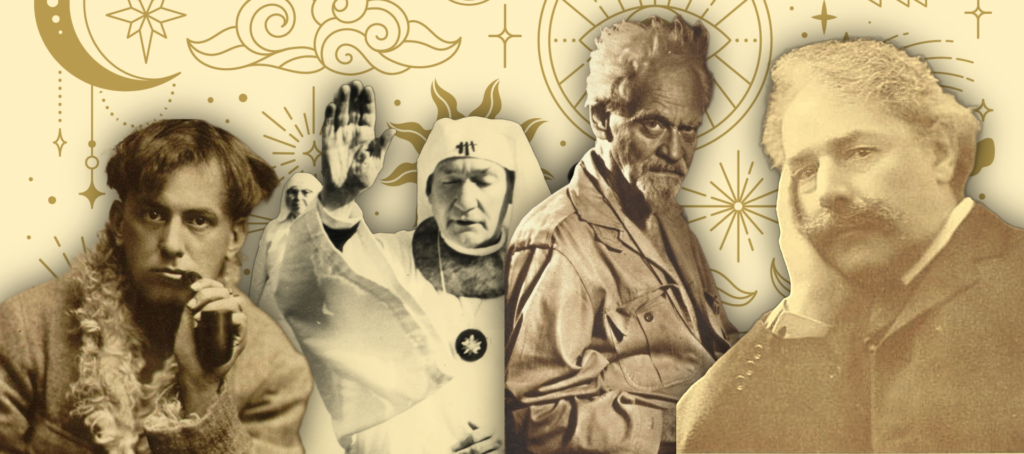
So let’s get to the more modern of our pairs of influential British dudes.
The Wheel of the Year, as it circulates in Neo-Pagan and Wiccan spaces, is a calendar of eight sabbats spaced more or less evenly through the solar year: the solstices, the equinoxes, and four cross-quarter days between them. If you’ve spent any time in pagan or new age circles, or just around folks trying to make new traditions outside of the church, you’ve probably encountered this calendar. It’s become the default nature-based holiday framework for a lot of western individuals and families who are building their spiritual lives outside the Christian church, which is a lovely impulse, and the calendar serves it reasonably well as a foundational structure.
The eight-sabbat Wheel as a unified system was assembled in the mid-twentieth century, primarily through the work of Gerald Gardner and Ross Nichols, the founding figures of modern Wicca and contemporary Druidic practice respectively. The wheel of the year does not comprise however, a continuous body of practice originating in Celtic antiquity, which is how it is most often presented, if not directly, then by very strong implication. Gardener and Nichols were creative, interesting people doing something inventive, but they were not, through their work, preserving a pre-Christian religious lineage.
Some of these sabbats have genuine historical roots in cultural celebrations; but a solid chunk, Ostara, Mabon, Litha, were named to echo existing, non-holiday related stories, and added to the Wiccan wheel in the 1960s and 70s. Of the countless actual historical celebrations that existed across the cultures this tradition draws from, these eight were selected. It was a deliberate curatorial decision, and it’s silly to pretend otherwise. Isn’t curation supposed to be chic?
Again, invented practices are valid. I think you can (and should!) build meaning from the available ingredients that speak to you, and have it be real and powerful and worth your devotion. The need to claim antiquity suggests that the people doing this work don’t fully trust the argument that underlies invented practices, though that argument is a strong one: ritual works because of what it does to the human nervous system, and it does not require a lineage stretching to the Iron Age to be real. If you believe that, then you should be able to say “I made this up, I think it’s cool, and it works for me and it might for you too,” without needing to borrow authority from a past that didn’t produce it.
Ostara is a case where it gets critical to look at things closely because associated false history is still actively harmful.
The claim, as it usually goes, is that Easter is a Christianized version of a pre-existing Germanic pagan celebration of spring, named for a pan-Germanic goddess called Ostara, and that the familiar symbols of Easter, eggs, hares, flowers, are remnants of her ancient fertility cult. The Christians, in this account, co-opted the holiday and stripped out its pagan origins.
But what about the real historical record? There is a single reference, from a monk named Bede in 725 CE, to a goddess called “Eostre,” offered as an explanation for why a particular month in a geographic region was called by that name. There is no supporting evidence or details; no shrines, no inscriptions, no other references in any other source. The word shares a linguistic root with a cluster of words associated with dawn: aurora, eos, the Vedic Ushas, so the connection to spring and light makes etymological sense, but etymology is not mythology, and a shared root word does not specifically indicate a shared goddess.
The goddess Ostara, complete with hares and eggs and the full fertility iconography, was not recovered from antiquity. She was created in 1880, by Jacob Grimm, (yes, that Grimm) for a book on Germanic mythology. The hare-drawn sleigh and associated imagery appear after that publication. Before Grimm’s creative work, none of it existed in any documented form.
The eggs have a much cleaner origin story: Passover, which predates Easter by millennia and has been associated with eggs for thousands of years, and which is liturgically and historically tightly bound to Easter. The hare’s association with Easter comes from an observation about hare biology; specifically, the way a hare can become pregnant with two litters at slightly different timings, which made it appear capable of something resembling virgin birth to early observers.
These are the Jewish and natural-historical roots of the imagery. The insistence that they must instead trace back to ancient European paganism, rather than the much more obvious connection to Jewish tradition, is eurocentrism at its most classic.
All of this I could possibly shut up about, and set aside as the kind of well-intentioned creative mythology that pagan traditions are full of, if not for one additional piece of context. The name Ostara was taken up enthusiastically by the Nazis, who used it for an antisemitic magazine in the early twentieth century, and who had their own deep investment in constructing a pre-Christian Germanic spiritual lineage. The holiday’s incorporation into the Wiccan Wheel of the Year happened decades after that association was established. The narrative that Ostara is an ancient Germanic holiday stolen by Christians, a narrative that also purposely erases the Jewish roots of Easter imagery, and is not a neutral piece of folk history. It is Nazi propaganda that has been filtered through the new age section of the bookstore.
I am not suggesting that everyone, or even most people, who celebrate Ostara are Nazis, or are doing anything other than following a calendar that was handed to them as “ancient and pagan.” I do think the false history matters, and that the people I know who celebrate Ostara are the sort of thoughtful people who would, deep down, probably rather know if they are inadvertently spreading white supremacist propaganda, and that this is one of the clearest examples I know of why the origins of our practices are worth tracing with honest rigor.
“But we lost all the women’s wisdom! It was burned! THAT’s why we don’t have record of these faiths!” The argument goes: of course we don’t have hard evidence for the ancient roots of these practices, because women’s wisdom traditions were systematically suppressed and destroyed, and “absence of evidence is not evidence of absence”. It’s true that patriarchal institutions have and continue to destroy plenty, BUT! ALSO! Very rarely if ever could they wipe something from the record completely, humans as a whole aren’t that controllable or organized, and if you go looking you can eventually find evidence of countless faiths that faced extremely intense suppression. AND it’s massively disrespectful to the very women it wants to honor, because it erases the ones we have, who are excellent and plentiful.
Even if we limit our search to only the UK, Europe and The Levant: We have the classic Celtic warrior woman, Boudicca, documented in Roman sources as a formidable military and political leader who nearly drove an occupying empire from her island. We have Hypatia of Alexandria, a mathematician and philosopher with a documented school and students, murdered for her public intellectual life. We have Hildegard of Bingen, who left behind a body of work; music, theology, medicine, natural philosophy, so vast it still isn’t fully catalogued. We have Julia Domna, who convened her own philosophical circle at the Roman imperial court and is credited with commissioning major works of ancient biography and philosophy. These women existed in conditions far more hostile to women’s public life than most of us face, and they still left fingerprints everywhere.
The claim that genuine ancient women’s wisdom traditions would have vanished without a single corroborating inscription, a single reference from a hostile source, a single archaeological trace, while simultaneously insisting those traditions were widespread and culturally central, just doesn’t hold up. What it does do is keep the invented traditions immune from the same scrutiny we’d apply to any other historical claim, by conscripting real women’s erasure as a shield for a much more recent fiction.
And that’s before we even get to the mythological record, which is vast and largely uncontested. Inanna, the Sumerian queen of heaven, has a descent narrative that predates most of what we call Western civilization and remains one of the most psychologically rich pieces of literature we have. (If you can’t already tell, I really love this one).
Hecate has centuries of genuine cult worship, inscriptions, shrines, and a role in Greek religious practice so significant that she survived into Byzantine Christian demonology, which is how you know she mattered. Brigid was important enough that the Catholic church had to make her a saint in an attempt to absorb and effectively erase her, without success. Freya has the Eddas, which are not ancient by some standards but are documented, attributed, and continuous. The Morrigan shows up in enough distinct sources to constitute a legitimate tradition.
If what you want is a goddess to orient a spring celebration around, one whose roots you can trace and whose stories richly repay your genuine engagement, you are not short of options. When you stop and look, the made-up ones are an odd choice when the real ones are right there, even more strange, demanding, and worthy of your reverence.
So why does this keep happening? Why do western invented practices so reliably reach for false antiquity?
Here’s my take: A person who learns to build their own rituals, to read their own symbolic landscape, to trust their own interpretive capacity, that person is not a worse practitioner, but they are a less reliable customer. The western “new age” industry, and the broader cultural marketplace that surrounds it, has limited structural incentive to help people develop a significant level of true self-trust.
The fabricated lineage, the implication that you need access to ancient wisdom held by initiated practitioners, the idea that SOMEONE ELSE has tapped into a gift that will give them YOUR ANSWERS, which they can then provide to you, it all functions to keep people dependent on institutions, gurus, and products rather than on their own capacity for meaning-making.
The predictable shape that commercial incentives give to meaning seeking communities doesn’t require a coordinated conspiracy, capitalism and individual ego has it all taken care of.
A few generations of practice can and do add to the effectiveness of ritual; the accumulated resonance of a practice that has been used, adapted, and passed down across even what feels like a shorter period of time, is real and measurable. But without the honest historical context, what you have is a hollow copy of that resonance; a simulation of depth.
Tarot illustrates what an alternative looks like, what a practice can be when it’s relatively honest about its own origins, even if modern practitioners may be unaware of the youth of its roots.
Tarot is having a cultural moment. I own a fully licensed Disney™ Nightmare Before Christmas tarot deck, among many others. There are tarot and oracle deck displays in every bookstore I walk into. My ten-year-old knows the full Major Arcana without my having taught him, because of how many video games utilize the card names and symbols. It has become mainstream in a way that would likely surprise the people who most influentially shaped the tradition we now use.
Those people were more nerdy British guys; members of The Hermetic Order of the Golden Dawn, a British secret society active around the turn of the twentieth century, organized around occult practice; divination, astral travel, ceremonial magic, and related arts, inspired by the Freemasons and the Rosicrucians. Two of its members, Arthur Waite and Aleister Crowley, were the primary authors of what are now the two most widely used tarot systems: the Rider-Waite-Smith Tarot and the Thoth Tarot.
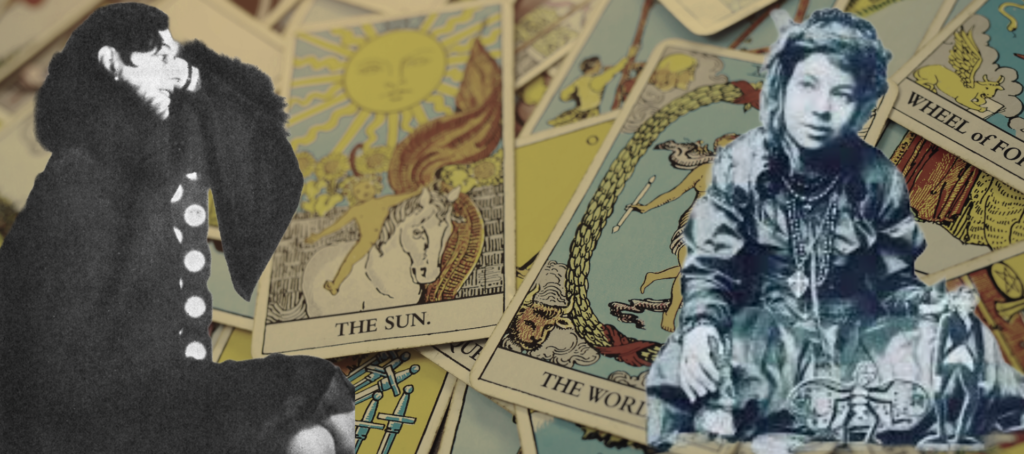
Each had an extraordinarily talented and diligent woman behind the visual work that made their systems what they are. Pamela Colman Smith illustrated the Rider-Waite-Smith deck, and her visual interpretations of Waite’s written interpretations are what shape most tarot practice today; she is the reason the cards look the way they look in your mind’s eye when you think of tarot. Lady Frieda Harris not only illustrated the Thoth Tarot but financially supported Crowley throughout the project, which would not have existed without her.
Before these two pairings of author and artist, tarot had only recently become used as divination tool at all. For the first three hundred years of their existence, tarot cards were an Italian variation on playing cards. The first deck created specifically for divination appeared in the 1770s, heavily implying Egyptian origins it did not have, another appeal to false antiquity, and a familiar one. Europeans and Brits alike at the time were mad for the colonially pilfered magics of Egypt.
While Waite and Crowley, roughly a hundred and twenty-five years ago, did tie the cards’ imagery to older traditions, primarily Egyptian and Kabbalistic (a form of Jewish Mysticism), and both were fairly clear that these were not fortune-telling tools in the “a dark man will soon arrive” sense despite the place they have come to rest in our cultural impressions, and they did not claim the tarot to be older than it was (though Crowley DID come up with a whole very bizarre religion that absolutely DID attempt to grant itself objective grounding in some kind of privileged spiritual knowledge given directly to him. That being said): with their tarots, they acknowledged they were creating tools for moving a user through symbols, archetypes, and bodies of esoteric knowledge; ways of transmitting what they had spent their lives studying into something flexible, visual, and accessible.
The use of the cards doesn’t hinge on the historical references being taken as literal fact. The depth available in a tarot reading isn’t removed if you know the deck was designed in 1909. You are not erasing any essential part of the tradition by engaging with tarot as a secular mystic, because the tradition was always more about the symbolic framework than the supernatural machinery. This is where tarot and Neo-Paganism diverge, for me. Neo-Paganism, in its Wiccan form at least, is a specifically theistic practice, and its claims about lineage are load-bearing in a way that tarot’s aren’t.
If tarot represents the middle path; relatively recently invented by nerdy British guys, but pretty honest about the fact, then Discordianism represents the far, gleeful, fully committed end of the spectrum, and it is a movement in gonzo meaning making I’m always delighted to revisit.
In 1963, two young men in a bowling alley in California began writing a sacred text for the worship of Eris, the Greek goddess of chaos and discord. They chose Eris on the grounds that she was the only honest deity available, chaos being the one thing the universe demonstrably and reliably delivers. The resulting document, the Principia Discordia, is simultaneously an earnest philosophical argument, a very elaborate inside joke, and a sincere case I’d like to make also, that the line between those two things is not necessary for work to be worthwhile.
More zine than Bible, it found its way to author Robert Anton Wilson, who wove it into the broader counterculture, where it proceeded to do exactly what it had theorized about: people received it, passed it on, and began treating it as real.
The modern “Illuminati” as cultural obsession, still generating conspiracy theories at an impressive rate, is substantially a Discordian art project that got away from its authors, which they had more or less predicted, and which they found very funny.
What I love about this tradition, if you can call it that, is the quality of the freedom it models. Nobody who has read the Principia Discordia is under any illusion that Eris is waiting for their offerings. The joke is visible from every angle. And yet people have built genuine practices around her, found real orientation in the cosmology, and done it all while laughing, and often while making more art.
That is what the freedom I wish for us all looks like when someone runs all the way to the peak with it: not solemn and defensive, not borrowing credentials it doesn’t have; fully alive to its own absurdity, and therefore inherently more honest and useful.
You are allowed to build something that knows it’s been built. You may find that more enjoyable and more sacred than the alternative. It is the same with those who have decided to adopt the Earthseed religion based on the novels of Octavia Butler, or Kurt Vonnegut’s Bokononism. (I can’t help but contrast these with Scientology, also founded on the work work of a sci-fi novelist, but which instead pretends to objective reality, and we see the problems that have arisen there.)
You can see this confidently scrappy creativity in how I observe for seasonal holidaysinstead of the prescribed Wheel of the Year, I build my own, and while some celebrations return each year in much the same forms, others rise and fall as the years go, and the people in our family and community grow and change.
The Atheopagan practice I orient myself around suggests we do exactly this: rather than inheriting a calendar assembled by twentieth-century British and American occultists and retrofitted with a veneer of antiquity, you observe what happens in your little corner of the world, in your body, and across the turning of the years you personally live. You notice when the light changes, when certain creatures and plants appear, when you feel the seasonal shifts in your own animal body, and you build your observances around those local, personal rhythms. This year I got really into Arbor Day, which I intend to more plan in advance next year, (though I did happen have two trees on hand to plant!) and for which John Denver is very much my patron saint.
This is, at least from my view, what the modern impulse to adopt the Wheel of the Year is reaching for; something honest about human beings and the natural world that acknowledges we are animals with seasonal lives, that makes space for the numinous without requiring adherence to traditions that may otherwise be at odds with our personal convictions.
Beltane, the holiday I’m asked about this time of year, offers a fitting illustration. May 1st does have a continuously practiced celebration attached to it, one with over a century of documented tradition and living lineage, one that has been carried forward by communities with serious stakes in its continuation. It’s just not a pagan one. May Day, International Workers’ Day, grew from the labor movement’s long and usually brutal struggle for basic human dignity; child labor laws, the eight-hour workday, the weekend, the right to organize, and has been observed by working people around the world since the late nineteenth century.
May Day is a tradition with depth, continuity, and its authority flows from the people who fought and bled for it. I cannot help but feel a bone deep, lump-in-my-throat reverence when faced with that lineage of meaningful human action. It gracefully illustrates how unnecessary the implicit suggestion is that a holiday only counts as spirituality if it involves a goddess and a bonfire, because the workers who built that movement were human animals, embedded in the natural world, whose bodies and communities and futures were shaped by the same forces that shape everything else alive. Solidarity is not separate from the web of life. It is one of the forces that the web of life is held together by.
The through-line, for me, across all of it: Pay attention to the ingredients of your existence that appear before you, and know that real or fiction, the stories you and yours find meaningful, are just as worthy of reverence, if not more so, than any institutionally backed mythology, no costuming required.
Further Reading/Watching:
Gerald Gardner & Ross Nichols
Debunking Myths About Ostara
Warriors, Queens, and Intellectuals: 36 Great Women before 1400 (this is a link to a site where you pay for the course, but I was able to get access through my library’s digital subscription to Kanopy, and if you know someone with Amazon Prime sometimes you can get it on there pretty cheap. I do REALLY recommend it.)
History of Tarot Cards
History of the Illuminati (this is an awesome series FYI, one of my top podcast series ever, also can be found on spotify and apple podcasts.
Earthseed Religion
The Books of Bokonon
How L. Ron Hubbard Lied His Way to Godhood (another great podcast series from the same folks who brought us the above Illuminati history)
Writing Your Own Wheel of the Year
May 1: International Workers Day